
- Home
- In-depth Articles
- Marking An Improvement
Marking An Improvement
Co-creating and implementing a new feedback policy
– By Harry Birch
St Mary Magdalene Academy (SMMA) has always put happy and successful pupils at the heart of everything it does. As in many schools, teachers at SMMA diligently followed a marking policy, ensuring that books were taken in regularly to be marked, often with detailed written comments.
Whilst marking a pile of books can be a satisfying task to complete and beneficial to some pupils, research suggests this is often less impactful than hoped. Many staff were also keen to experiment with different methods of providing pupils with more targeted feedback on their work. This article outlines how SMMA moved away from a focus on marking and towards student-centred feedback.
In many ways, the SMMA marking policy followed the traditional method of marking books. It involved ‘light touch’ marking (primarily focused on presentation) and 'in-depth' feedback (requiring a written positive comment, and an area for improvement on a piece of work). Sometimes this could involve the onerous ‘triple marking’. Some teachers and departments viewed this as a strong methodology, meeting the needs of pupils and clearly visible in the books. However, other teachers were keen to explore news ways of giving feedback to pupils – such as ‘whole class feedback’ which the policy did not strictly permit.
The issue is not only found at SMMA: the desire to move away from many written comments and onerous marking has been seen throughout the education sector. Marking is frequently mentioned as one of the tasks which contributes most to a teacher's workload.
A Teacher Tapp survey in 2019 found that 82% of teachers nationwide agreed with the statement ‘If I wrote no written comments in my students' books, they would learn as much as they do at the moment’.
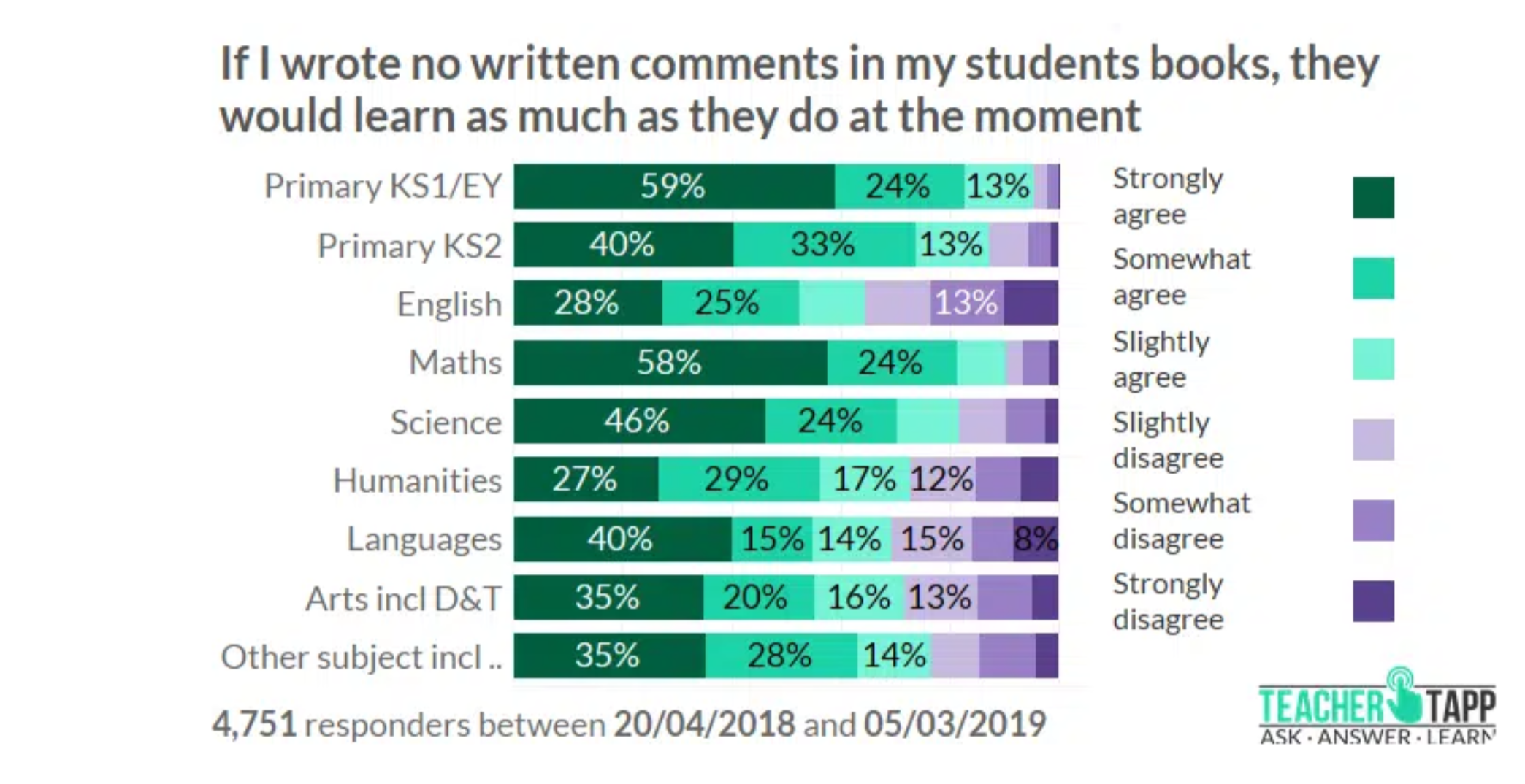
This raises the question: if so many teachers think written comments are not making a difference, why are they doing it? This statistic also exemplifies an age-old discussion in education: what really makes a difference to how pupils learn, and how we can ensure teacher time is used efficiently and effectively?
In light of the views of SMMA staff and the wider teaching community, it was agreed that a review of the marking policy would be carried out. The process initially involved putting together a working party of staff across the school to share the current marking and feedback practices in their departments. This cross-section was vital to ensure all views would be represented; the Teacher Tapp survey question (‘If I wrote no written comments in my students' books, they would learn as much as they do at the moment’) had shown a great disparity between subjects. For example, twice as many maths teachers strongly agreed with the statement, than English teachers.
To ensure the working party discussions were as constructive as possible, it was important to embed the discussions in educational research. The first session involved looking at the Education Endowment Foundation’s 2021 review into feedback and other articles/ blogs around feedback. It was agreed that the separation of ‘light touch’ and ‘in-depth’ feedback styles was useful, making clear the different purposes for looking at a pupil's books. To enrich and make ‘light touch’ marking more efficient, some teachers shared they were using stampers to acknowledge good work, rather than written comments. This was popular when trialled by other working group members as excellent work became quick to praise, and released more time to make useful corrective comments. To clarify the purpose of this type of marking and feedback, it was decided that 'acknowledgement of work’ was a more suitable name than ‘light touch’.
Given the diversity of what pupils need to do in different subjects, it was less easy to agree how in-depth feedback should look. In some subjects redrafting a key paragraph or analysing a model answer might be the most suitable task; in others, answering a series of questions to revisit key knowledge may be more appropriate. The natural solution was to create a policy with key expectations that all faculties should follow, and to then allow each faculty to develop its own guidelines for staff with specific detail and examples of excellence. SMMA has a strong reputation for trusting teachers to use their professional judgement in deciding what is best for their pupils, so explicitly including reference to this was also considered important.
The most important outcome of the working group was putting together the five key principles of marking and feedback at the Academy. These were based on research and the ethos of the school. They are especially powerful as, although they were subsequently reviewed by Heads of Faculty and SLT, they remain almost unchanged from the initial working group’s suggestions.
The 5 Principles
- The process of marking informs staff on pupils’ learning, strengths, and areas for development. We use this to influence future teaching as well as the feedback students receive.
- At SMMA we use marking to acknowledge the hard work pupils do, reward pupils, and notice common errors.
- Feedback should have a positive impact on pupil outcomes. It takes many forms and teachers use professional judgement to decide how to give feedback.
- Time should be given for pupils to act on feedback given.
- The timing of feedback is down to the teacher's professional judgement, in the context of their subject.
Once these school-wide principles had been agreed with Heads of Faculty and SLT, the focus turned to the creation of faculty-specific guidance. This was a crucial stage in the implementation of the new ideas. We began to shift the whole school focus onto marking and feedback through a number of whole school CPD sessions, sharing research and encouraging staff to consider their own practice. Adapting habits and long held beliefs is always challenging, so encouraging a collaborative approach was important to maximise engagement.
The creation of the faculty guidance was led by the Heads of Faculty in a series of CPD sessions. These involved reading research, structured discussions and opportunities to create feedback activities. Staff were encouraged to bring their own examples of where they felt feedback had been effective in helping pupils make progress and trial the new ideas in lessons. These successful examples were included in the guidance documents as examples of good practice. Many staff took the opportunity of gained time in the summer term, to experiment with new feedback strategies, then subsequently shared what they felt had worked well, and what had not. By the end of the summer term, all faculties had strategies that aligned with the school principles, and maximised the opportunities for feedback to allow pupils to make great progress.
We also agreed that all faculties would print their key in-depth feedback tasks on yellow paper, to draw attention to the importance of these activities. Pupils already knew that teachers mark work in green pen, and students make corrections in red pen. The yellow sheet was a natural extension to this, making clear to students they should be learning from mistakes, and developing answers. It also made clear to pupils they were frequently receiving feedback, and they could find it easily in their book.
The implementation of the excellent feedback strategies was a school-wide priority in September. Given the busyness the start of term brings, it would have been easy to fall into old habits. To keep the focus high, we scheduled a ‘book fest’ just before half term. This involved staff bringing along the books they felt best showed the new feedback principles in action. There was then time for staff to circulate, pick up new ideas, and give ‘praise cards’. All staff also received SMMA-branded stamps to highlight ‘excellent work’ and add ‘even better if’ comments quickly.
An open and honest culture about what was working well, and what needed refinement, was essential. Much of this process was exciting and very positive. However, having fewer prescribed methods on feedback techniques did raise challenges around how to ‘quality assure’ the feedback process. To support this, one year after the initial implementation, we introduced termly ‘book looks’ where senior staff review a class set of books and give the teacher feedback.
We are now at a stage where the principles of the new feedback policy are firmly in line with faculty policies and embedded in the school. Pupils appreciate having detailed in-depth feedback, and – crucially – can be seen acting on their feedback on yellow sheets. Exercise books look loved with the ‘SMMA Excellent Work’ stamper often used, and suggested improvements acted upon. The focus has firmly moved from marking to high quality feedback.

